

Inside the offices of the Lyn and Daniel Lerner Visitor Center—home to teams across horticulture, plant science, membership, marketing, finance, and more—a quieter layer of the work unfolds: wild flowers line the walls. Not photographs, but intricate botanical illustrations, each one capturing a plant with remarkable precision.
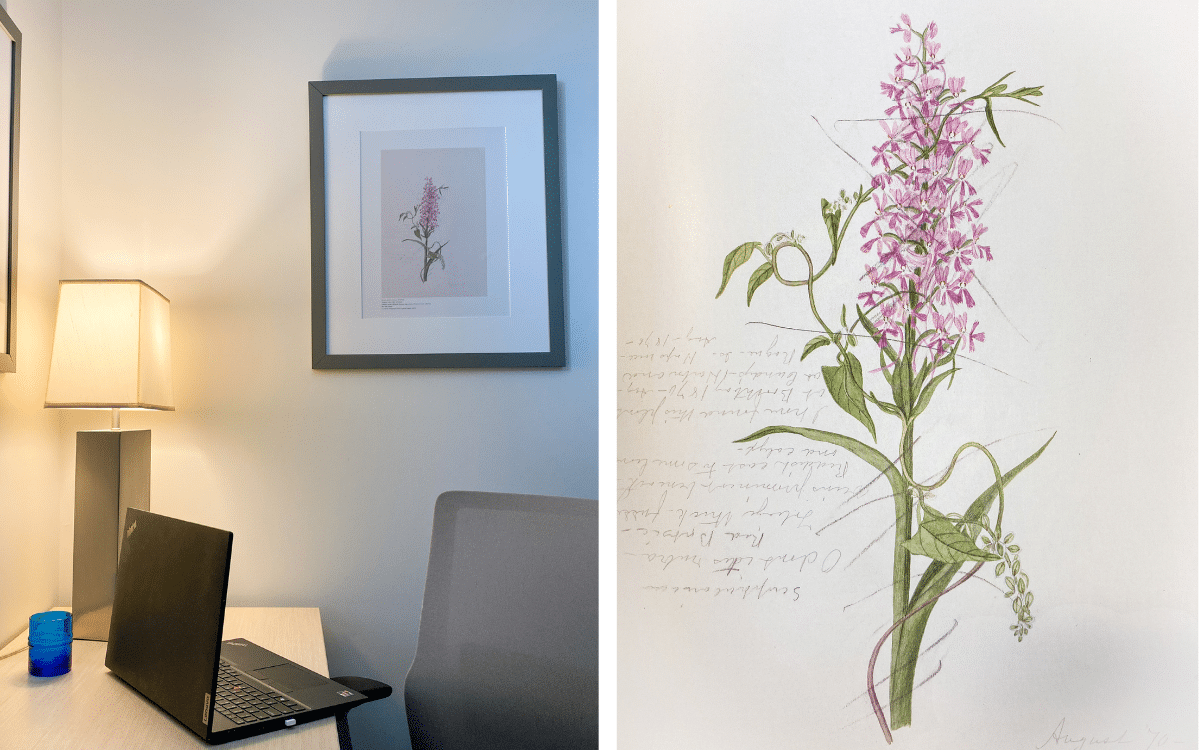
These images originate from the life-long work of Catherine “Kate” Furbish, a botanist, artist, and careful observer of Maine’s flora. From 1870 to 1908, Furbish traveled throughout the state, collecting, classifying, and illustrating its plants with extraordinary dedication. Her life’s work took shape in Maine Flora, a fourteen-volume collection of botanical illustrations and notes, which she donated to Bowdoin College in 1908.
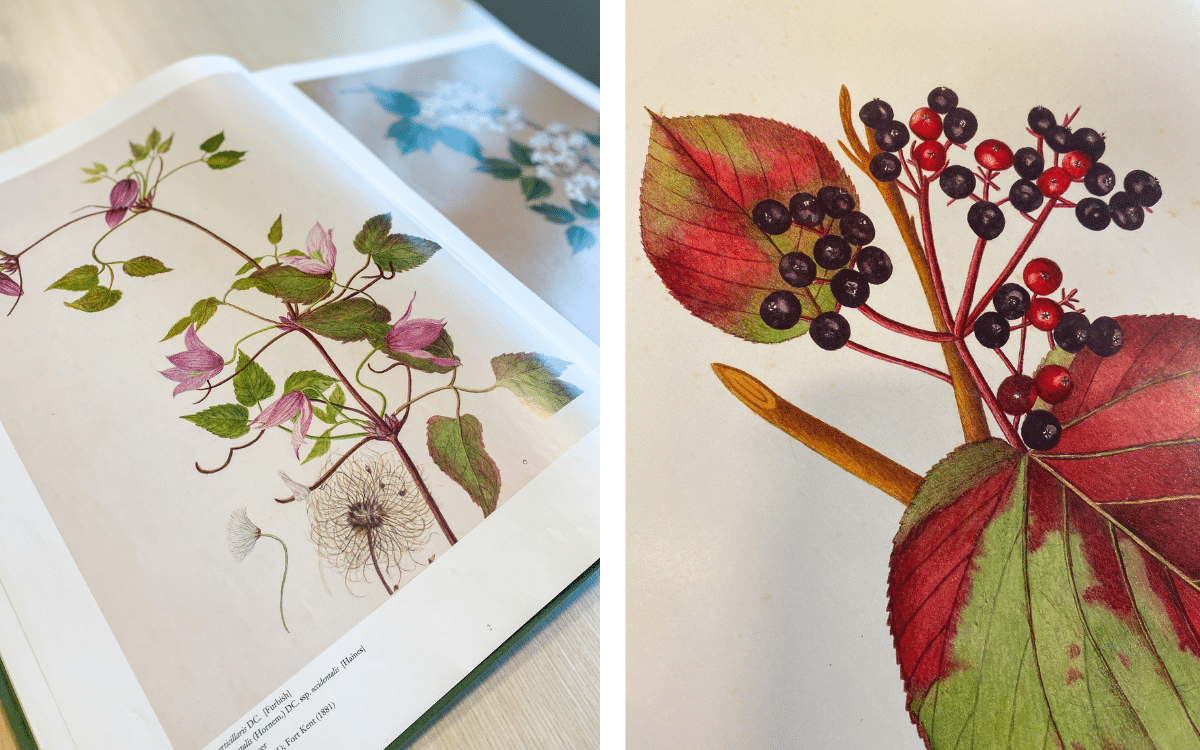
Catherine ‘Kate’ Furbish – (Left) Clematis verticillaris DC. Virgins Bower – (Orno 1881 Fort Kent 1881) | (Right) Viburnum lantonoids Michx. Hobble Bush Location Brunswick (1876)Plants and Flowers of Maine: Kate Furbish’s Watercolors
That legacy was brought into a new form in 2016 through Plants and Flowers of Maine: Kate Furbish’s Watercolors, a comprehensive two-volume publication. The set faithfully reproduces nearly 1,300 of Furbish’s drawings, produced by Bowdoin College Library and Rowman & Littlefield in collaboration with Coastal Maine Botanical Gardens, making her work more accessible than ever. Our connection to this work runs deeper still. Botanist Melissa Cullina, Vice President of Plants and Science at the Gardens—and a self-confessed “Furbish fan”—authored the foreword.
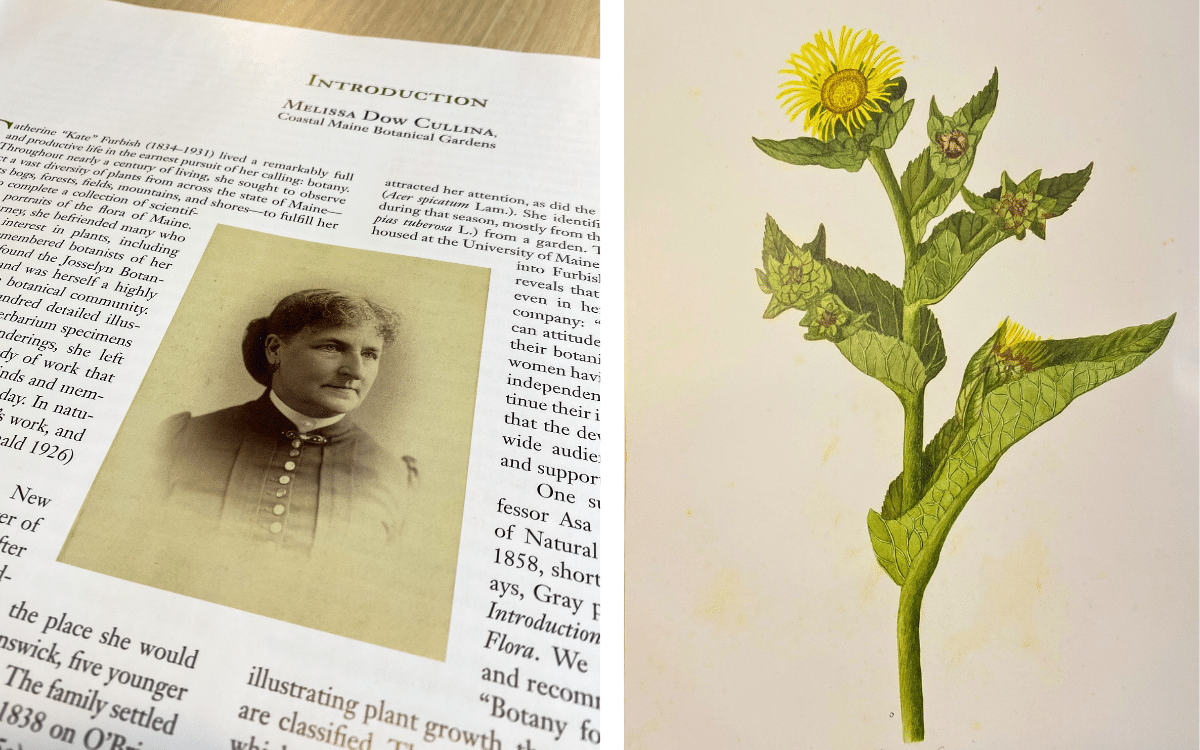
Catherine ‘Kate’ Furbish – Plants and Flowers of Maine: Kate Furbish’s Watercolors
Beyond the scale of the publication and preservation of the work, it is the illustrations themselves that continue to captivate. What’s striking to the modern observer is how contemporary the drawings feel, with little of the ornate sensibility often associated with the late 1800s. Instead, Furbish’s work is crisp, direct, and remarkably clear, reflecting her commitment to accuracy above all else.
In a letter to Bowdoin College president William DeWitt Hyde dated December 22, 1908, she wrote, “I do not claim artistic merit but merely a truthful representation of what I saw in the plants, free from all decorative effects.” That philosophy is evident in every composition.
The Gardens’ appreciation for these renderings reflects something more than aesthetics—it speaks to the way we approach our work: rooted in place, grounded in observation, and closely tied to the landscapes that surround us. Botanical illustration, at its core, is not simply about beauty: it is a scientific practice. Long before photography became widely accessible, illustration was one of the most important tools for documenting plant life.
Even today, it offers something unique. An illustrator can capture multiple stages of growth: bud, flower, and fruit within a single composition, while highlighting the features that allow a plant to be accurately identified. These are details that are often difficult to isolate in photographs but can be rendered with clarity through careful study. Furbish worked from life, often using multiple specimens to create a single, truthful representation. Each composition is the result of close, sustained observation.
Click the video to flip through a few of the pages.
She also recorded where in Maine her specimens were gathered, often preserving these as herbarium sheets, grounding each illustration in place and offering insight into the environments where these plants thrive. Together, image, herbarium specimen, and notation form a more complete understanding of the plant and its structure, habitat, and context.
In this way, the illustrations are reminders of how we come to understand plants in the first place. They reflect the process of looking closely, asking questions, and translating complexity into clarity. That same process is central to the work happening here every day, from the horticultural team designing and tending garden beds, to the marketing team feeling inspired by a particular plant’s colorway and storytelling, to the development of field guides and interpretive signage.
This relationship between art and observation extends beyond these office spaces. In the Bosarge Education Center, the Herbarium preserves plant specimens that document the region’s biodiversity—each one holding data about where and when a plant was collected, offering insight into changing climates, shifting habitats, and biodiversity over time. Far from a static archive, the herbarium is an active research tool, supporting ongoing study and conservation work.
New Exhibit in the Bosarge Education Center this Summer.
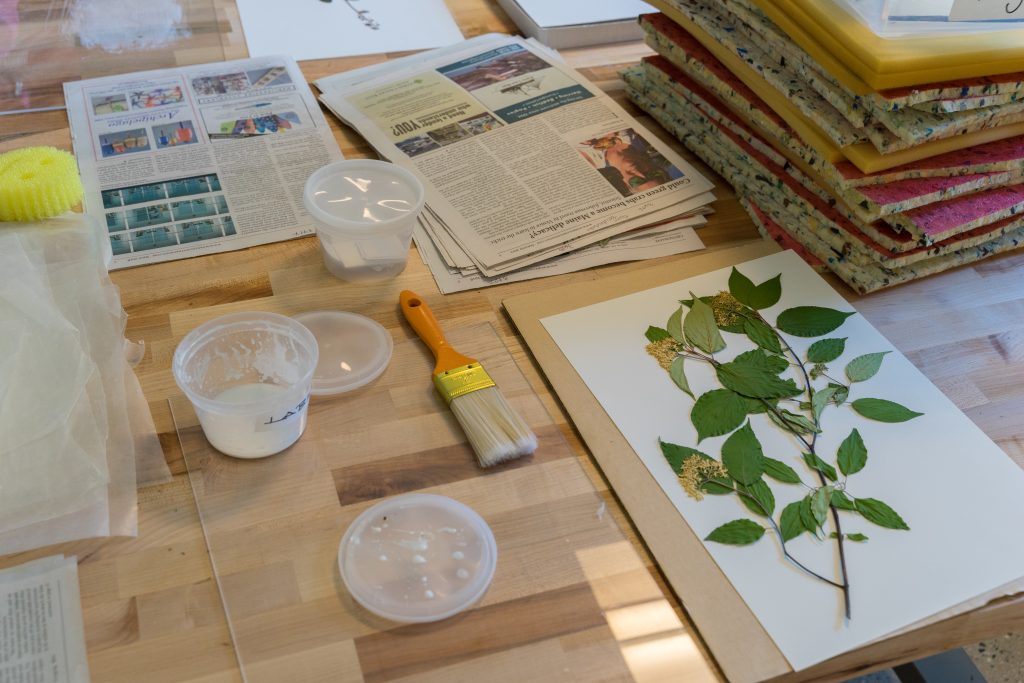
On view In the Education Center this spring and summer, Plants Over Time: Unlocking Herbarium Collections highlights selections from this collection, showcasing both the art and science of herbarium work, including contributions by botanical artist Joy Grannis.
Drawing from herbarium specimens is a skill in itself, offering both clarity and challenge. There is something undeniably useful about working from a specimen: it is still, accessible, and safe from the wind, weather, or mosquitoes! An artist can take time to observe closely, returning again and again to the same subject. Specimens also allow for direct comparison; plants gathered from mountainsides and seashores can be studied side by side, revealing subtle differences in form. The curve of a thorn, the shape of a leaf, and the smallest distinguishing features become easier to isolate and understand.
At the same time, there are limitations. Pressed specimens do not always retain their original color or shape. The work of the illustrator, then, becomes one of interpretation as much as observation.
The exhibit also explores the growing role of digitization, which allows researchers worldwide to access high-quality specimen images and data. These digital records not only expand opportunities for study, supporting worldwide research, but also serve as a safeguard, preserving the collection in the event of loss or deterioration.
Surrounded by these images, the boundary between indoors and outdoors begins to soften in small, quiet ways through a familiar (or not-so-familiar!) bloom rendered in ink, watercolor, and pencil.
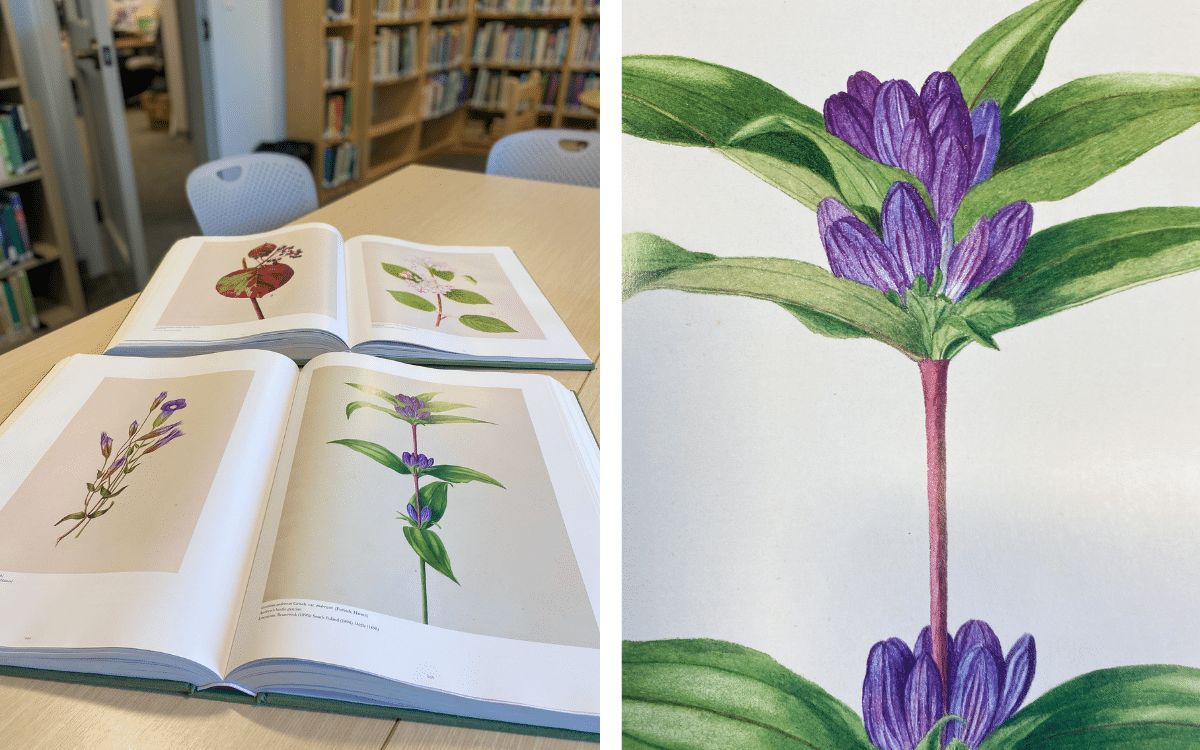
(Left) The two volumes from our library at Coastal Maine Botanical Gardens | (Right) Details from Furbish’s drawing: Andrews Bottle Gentian Gentiana andrewsii Griseb Var Andrewsii
These illustrations form a kind of visual language—one that speaks to both art and science, observation and understanding. They remind us that the study of plants begins with truly seeing them, and that even in the spaces where we work, we remain closely connected to the natural world that inspires them.