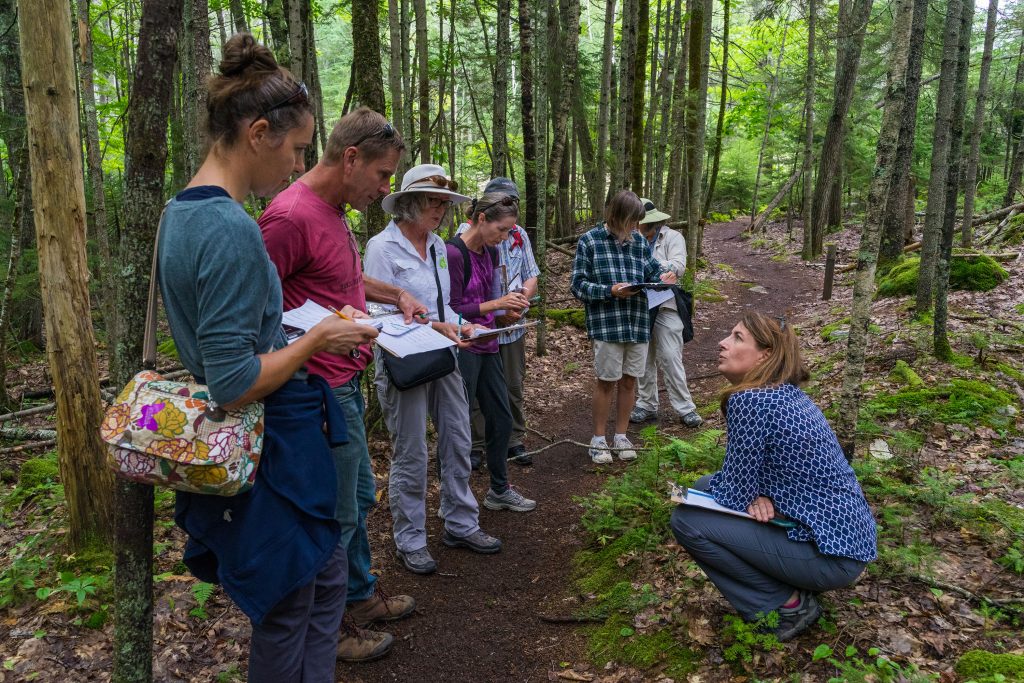
As part of our commitment to plant science and conservation, Coastal Maine Botanical Gardens has partnered with student researchers across the state, providing advising, resources, and mentorship. Earlier this year, the Gardens began a partnership with the University of Maine (UMaine) that gives graduate students the opportunity to work alongside researchers and plant science professionals at both organizations, while advancing mutual research initiatives.
Meet Zach
Zachariah Green, a master’s student in UMaine’s Horticulture program, is researching native plant cultivars and their wild counterparts. Green, originally from California, received his undergraduate degree in Horticulture and Urban Agriculture from the University of Idaho. He previously worked as a student lab assistant at the Cuesta College Plant Science Facility and as a groundskeeper at the University of Idaho Arboretum and Botanical Garden.
As part of his residency at the Gardens, Green is now exploring an important question about conserving Maine’s native plant populations: Does planting native cultivars near wild populations affect the wild population’s chances of survival and reproduction? This project is co-chaired by Melissa Cullina, Vice President of Plants & Science at the Gardens, and Bryan Peterson, Associate Professor of Environmental Horticulture at UMaine.
How does this help the Gardens?
Recently, Coastal Maine Botanical Gardens paused a native cultivar development program after questions came up about whether planting native cultivars near wild populations could harm the genetics and long-term health of those wild plants.
This study will guide the Gardens’ policy around cultivated varieties of native species and could have the ability to impact policy changes across public gardens and the horticulture field. The study focuses on three native plant cultivars and their respective native counterpart: foamflower (Tiarella cordifolia ‘Brandywine’), swamp milkweed (Asclepias incarnata ‘Ice Ballet’), and New England aster (Symphyotrichum novae-angliae ‘Purple Dome’).
The native New England aster (Symphyotrichum novae-angliae)
The cultivar foamflower ‘Brandywine’ (Tiarella cordifolia ‘Brandywine’)
The cultivar swamp milkweed ‘Ice Ballet’ (Asclepias incarnata ‘Ice Ballet’)
The cultivar New England aster ‘Purple Dome’ (Symphyotrichum novae-angliae ‘Purple Dome’)
These three species were chosen because they each have popular, widely available cultivars; they only have two sets of chromosomes, making genetic study easier; and they grow in wild populations that are common in Maine. Green’s research takes place at 18 field sites, with six sites for each species, across the MidCoast and Maine Highlands regions, with permission from local preserves and landowners. These sites were chosen because they have small but dense wild populations of each plant, making it easier to detect potential crossbreeding.
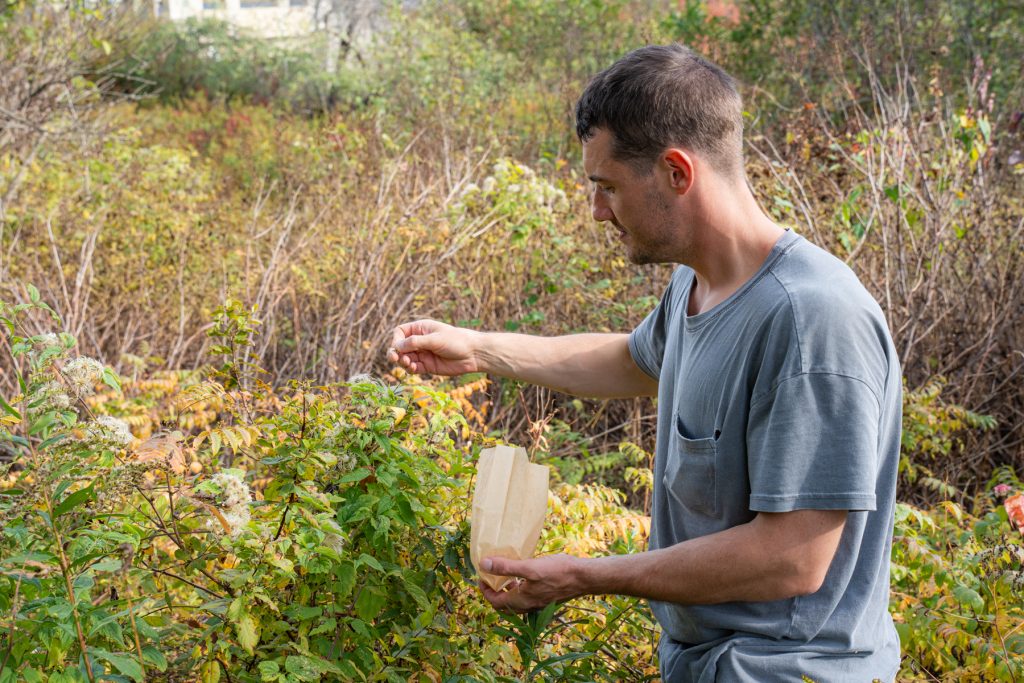
Zachariah Green shows the native swamp milkweed plant.
How is this study being done?
At each field site, Green planted the cultivated varieties next to their wild counterparts, making sure both are blooming at the same time. He records sightings of pollinators moving between flowers of the two plant types and later collects seeds and plant tissue samples for lab and greenhouse analyses.
To understand how native plant cultivars interact with wild populations, Green will grow seedlings from seeds collected from the wild individuals at each site, determine their parentage, and compare the growth of wild seedlings to the hybrid seedlings produced on the field sites. The results of this study will hopefully address a concern within the field that planting cultivated varieties next to wild counterparts will contaminate the genomes of wild populations and reduce their ability to survive and reproduce..
He recently collected the foamflower seeds and began genetic testing at UMaine. In August, he will collect the seeds and other plant samples from the swamp milkweed to begin testing, and will do the same with the New England aster in the fall.
This research project will conclude in 2027, but will leave behind important information to steer conversations, future research, and policies around native cultivars at the Gardens and possibly across the horticulture field for years to come.
Coastal Maine Botanical Gardens and Maine Natural Areas Program, with funding support from the Maine Outdoor Heritage Fund, are partnering to…
The mission of Coastal Maine Botanical Gardens is to inspire meaningful connections between people and nature and promote plant conservation through horticulture, education, and plant science.
To provide the best experiences, we use technologies like cookies to store and/or access device information. Consenting to these technologies will allow us to process data such as browsing behavior or unique IDs on this site. Not consenting or withdrawing consent, may adversely affect certain features and functions.
Functional
Always active
The technical storage or access is strictly necessary for the legitimate purpose of enabling the use of a specific service explicitly requested by the subscriber or user, or for the sole purpose of carrying out the transmission of a communication over an electronic communications network.
Preferences
The technical storage or access is necessary for the legitimate purpose of storing preferences that are not requested by the subscriber or user.
Statistics
The technical storage or access that is used exclusively for statistical purposes.The technical storage or access that is used exclusively for anonymous statistical purposes. Without a subpoena, voluntary compliance on the part of your Internet Service Provider, or additional records from a third party, information stored or retrieved for this purpose alone cannot usually be used to identify you.
Marketing
The technical storage or access is required to create user profiles to send advertising, or to track the user on a website or across several websites for similar marketing purposes.